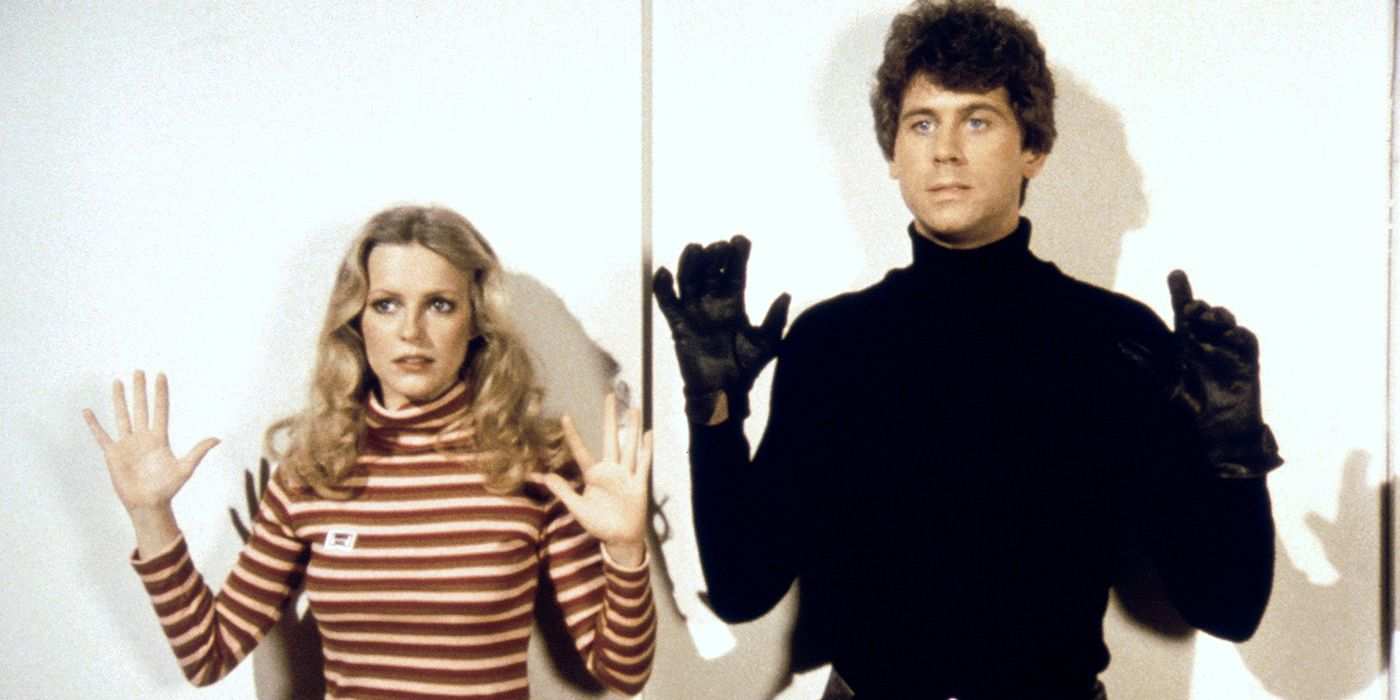
Charlie’s Angels‘ place in TV history is a complicated one. They were three smart, independent, and powerful women in a male-dominated field, a groundbreaking series in that regard. But on the other hand, the three leads were perpetually in bikinis, tight clothing, and other assorted outfits that accentuated their, shall we say, feminine wiles.
The series leaned heavily into the latter, placing the three women in situations that “justified” their attire, fighting evil men and women, and the “smart Angel,” Sabrina (Kate Jackson) was typically left working behind the scenes, attractive but not attractive enough, per the series, to rock the bra-less T-shirts and tight dresses the other two wore. As such, the problem with Charlie’s Angels is that it can’t be truly defined as to what it is, and is far more problematic to watch all these years later.
‘Charlie’s Angels’ Stuns Its Own Network

Charlie’s Angels was the vision of producer Leonard Goldberg, who came up with the idea for a show that combined The Avengers with long-forgotten Honey West, about a female detective. Originally called Alley Cats (the three leads were named Allison, Lee, and Catherine… clever), the series evolved into one about three strong women who work for a faceless man who gives them assignments over a speakerphone. The development of the series came with significant input from its lead, Kate Jackson, who also came up with the idea of calling the characters “Angels.” Charlie’s Angels was, initially, meant to be a star vehicle for Jackson, who was the bigger name at the time thanks to roles in Dark Shadows and The Rookies.
Farrah Fawcett, who had already gained a degree of fame thanks to her marriage to The Six Million Dollar Man star Lee Majors, was added to the cast as Jill Monroe, the “Athletic Angel,” while Jaclyn Smith came aboard as Kelly Garrett, also known as the “Streetwise Angel.” Jackson took on the role of the “Smart Angel,” Sabrina Duncan. With its three leads in place, Charlie’s Angels debuted as a pilot film in March 1976, and was a huge hit for the network. But ABC didn’t believe the staggering numbers the TV movie brought in, thinking it was one of the worst ideas for a TV series ever (per The Sunday Post). So they re-ran Charlie’s Angels the following week, only for the repeat to match the success of its original airing. The people had spoken, and on September 22 that same year, Charlie’s Angels debuted as a proper series.
ABC’s eventual faith in the series paid off with Charlie’s Angels not only as a ratings’ success — it landed the number five spot in the Nielsen ratings for the 1976-77 TV season — but as a strongly popular presence in pop culture as well, with magazine covers and merchandise, including the famed Farrah Fawcett “Red Swimsuit” poster, everywhere. Critics, however, largely hated the series, savaging it for the acting and the wardrobe, which was marginally thinner than the wafer-thin plots. According to one of the show’s costumers, producer Aaron Spelling wanted someone in a bikini in every scene. Fawcett, for one, knew exactly why the series was popular, saying (per The Sunday Post), “When the show was No 3, I figured it was our acting. When it got to No 1, I decided it could only be because none of us wears a bra.” As a result, Charlie’s Angels was credited with launching the era of “jiggle TV.”
‘Charlie’s Angels’ Sits Between Two Extremes
Given that she’s the actress most closely associated with the series, you might be surprised to know that Fawcett left at the end of the first season, still under contract. It triggered a lawsuit and animosity between her manager, Jay Bernstein, Spelling, and ABC, settled after Fawcett agreed to make limited guest appearances over the next two seasons (per CBS News). Cheryl Ladd was brought in to replace Fawcett, playing Kris Munroe, Jill’s sister. Jackson left at the end of the third season, unhappy with the scripts and with Spelling, who forced her to turn down an offer to appear in Kramer vs. Kramer, a role that fell to Meryl Streep, and was replaced by Shelley Hack as top-of-her-class recruit Tiffany Welles. Hack left after one year and herself was replaced by Tanya Roberts, a “streetwise fighter and model from New York” named Julie Rogers. Cancelled after five seasons, Charlie’s Angels never escaped the stigma of being little more than “jiggle television,” having earned its success for the wrong reasons.
But by dismissing it as simply “jiggle TV,” it places the series with the likes of Three’s Company, a show that really didn’t have much more to offer than just that, with the justification that it was the only reason Charlie’s Angels succeeded in the first place. In reality, it sits between the two extremes of exploitation and empowerment. The skimpy costumes and plots that had the Angels in situations, like posing as female prisoners, that afforded a rationale for those costumes, catering to Spelling’s demand for “a bikini in every scene,” are proof positive that the show was exploitative, and no one could ever argue against that. But it also empowered women, with Smith, for one, calling the series “groundbreaking” and “inspirational” in an interview with People, claiming she received letters of gratitude for the show’s establishment-challenging influence.
Ultimately, it comes down to this: Charlie’s Angels undoubtedly became a hit thanks to the beautiful women on the show, but at the time, it was the “deal with the Devil,” given a show with three women not necessarily deemed models would likely not have succeeded, thus pointed to as “proof” that women can’t headline an action series. A show like The Mary Tyler Moore Show, which is often cited as an argument that sexploitation wasn’t necessary for a strong female character to succeed, had the fortune of being a sitcom, a genre that had already begun establishing empowered women. Action dramas were arguably still well behind, so the “jiggle television” aspect may have brought people in, but it served as a Trojan Horse of sorts to tout the message of female liberation. It opened the door for the likes of Buffy the Vampire Slayer and the meta commentary of the Charlie’s Angels movie, which was allowed to do what the series could not by having the three characters own it and winking at the audience over the ridiculousness of it all.

- Release Date
-
1976 – 1981-00-00
- Showrunner
-
Ivan Goff, Ben Roberts
- Directors
-
Dennis Donnelly, Allen Baron, Don Chaffey
- Writers
-
Ivan Goff, Ben Roberts, Edward J. Lakso
- Franchise(s)
-
Charlie’s Angels