After 15 years, the story of Downtown Abbey comes to an end with The Grand Finale, as the aristocratic Crawley family and their beloved staff embrace the social changes brought on by a new generation.
It’s 1930, and in many ways, these changes are signified by Nöel Coward, the prolific playwright and performer whose works have made him the toast of the theater scene, from The West End to Broadway, and who was unmistakably homosexual—though that was not something discussed openly in polite society back then.
How about we take this to the next level?
Subscribe to our newsletter for a refreshing cocktail (or mocktail) of LGBTQ+ entertainment and pop culture, served up with a side of eye-candy.
In that sense, his introduction to the world of Downtown Abbey in The Grand Finale brings a touch of modernity and queerness to the proceedings, not to mention that beloved Coward wit.
Played by Arty Froushan (The Persian Version, Daredevil: Born Again), the Crawley company meets Nöel Coward through former butler Thomas Barrow (Robert James-Collier) and his partner, the actor Guy Dexter (Dominic West), who found love in 2022’s Downtown Abbey: The New Era and decided to move to America together.
In the Queerty exclusive preview clip from Downtown Abbey: The Grand Finale—in theaters everywhere September 12—Dexter and Barrow introduce their friends to Coward who, as you can see, knows how to make an impression:
If you’ve ever had the pleasure of seeing one of Noël Coward’s on-screen performances or hearing one of his recordings (like the timeless queer classic, “Mad About The Boy”), you’ll recognize that Froushan has done a remarkable job of bringing him to life.
Speaking exclusively with Queerty, Froushan shares how he prepared for the role, and the meticulous work he put into studying Coward’s physical mannerisms and way of speaking so that he could get the performance just right:
“I was very fortunate in that, only a couple of months before I auditioned for the role, a superb documentary (Mad About The Boy: The Noël Coward Story) had aired on the BBC, which painted an extremely intimate portrait of Noel and shed light on all the neuroses and sadnesses that haunted him, as well as his obvious brilliance, charisma and talent. I sort of fell in love with him after watching that and began foraging obsessively for footage of him as a young man, which despite his enormous fame was harder than you might think, since I was playing him at age 30 in 1930, and he didn’t start appearing on screen until his mid-thirties.
His first real film role was a 1935 drama called The Scoundrel, in which Noel plays a misanthropic publisher, so I dug that out and tried to absorb as much of his voice and physicality as I could, which again was tricky since his performance (new as he was to film) is incredibly stiff and mannered. But his famously distinctive voice – rapid, clipped and lethally dry – was there for me to emulate.
Weeks of vocal exercises ensued as I tried to master his machine gun-like diction and pithy punchline deliveries. I collected and scrutinized hundreds of photographs and clips of him (many provided by the wonderful Noël Coward Room in Holborn) and noted how he stood, how he leaned, how he smiled (deeply with his eyes when he meant it and thinly with a sardonic glint when he didn’t), how he held his cigarette with two slightly cupped fingers, and, of course, how immaculately he always presented himself.
To learn the song I had the brilliant Alex Parker, who taught me the piano part from scratch – a mad race against time since my repertoire hitherto was limited to four-chord Oasis covers – and guided me, with the help of Spotify, towards finding the plummy, quavering quality of Noel’s singing voice.
My handbook throughout all this was the magnificent Masquerade by Oliver Soden, which takes a more personal line than any of the previous Coward biographies and explores what was behind the mask as much as the mask itself.”
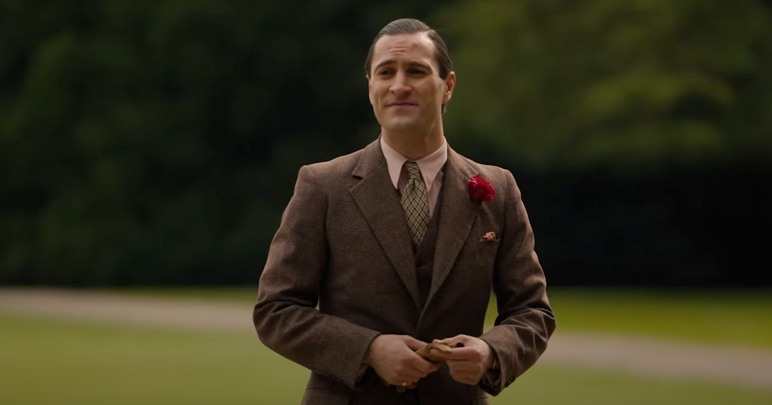
To know Noël Coward is to love him, Froushan came to realize, and as he learned more about the man behind the public persona—largely from his preserved personal correspondence, including that with his friend and late star of Downton Abbey, Dame Maggie Smith—he only felt more compelled to do him justice, and to bring a sense of authenticity to the role.
Here, Froushan shares how being a part of Downtown Abbey: The Grand Finale gave him an even deeper appreciation for the artist, and why Noël Coward is a role he won’t soon forget:
“I came to realize in my research that, for all his razzle-dazzle and pyrotechnics, Noël was an extremely tender, loving, often vulnerable man who gave so much of himself to so many people, which meant, I think, that there wasn’t much left for himself.
At the Noël Coward Room, I was shown folder upon folder of letters he’d been written by all his friends, fans, collaborators, mentors and mentees over the years; you’ve got Greta Garbo confiding in Noel about her depression, Maggie Smith cracking wry little jokes about mutual friends, Sean Connery and Frank Sinatra reaching out just to say hi; it’s essentially a century-spanning encyclopedia of anyone who was anyone in Hollywood, Broadway and the West End, and they all love – and I mean love – Noel.
Yet he suffered so much under the demands of fame, was taken advantage of by so many, and – amidst the obvious plaudits – was judged so harshly and impatiently by the sneering eye of the media and general public, for whom he was at first too much of an upstart, and then all too soon old hat. The son of a piano salesman, he came from such humble beginnings – easy to forget when witnessing his natural genius and elegance – and only ever wanted to bring joy and laughter to the wider world.
Whilst I’m not implying that Noel is or was in any way underrated as an artist or cultural figure, I do think he (the man and not the persona) was often under-appreciated and misconstrued. I came to see his life and career, though mythically successful, almost as a fable about the struggle to be accepted by a deeply critical, intolerant world.
He spent his life looking for safe harbor – a sense of belonging – whilst negotiating the rank homophobia of the time and the relentless expectations of show business, and managed to do all that with a grin on his face and an unfaltering twinkle in his eye. Of course there wasn’t time to explore all that in my performance in Downton, but it gave me a deep foundation of affection and compassion for him which meant I felt increasingly at home slipping into character, as well as a strong sense of duty in trying to bring at least a few honest glimpses of him back to life.”
To see how Arty Froushan captures the magic of Noël Coward and to say goodbye to Downton Abbey, don’t miss Downton Abbey: The Grand Finale exclusively in theaters beginning September 12, courtesy of Focus Features.
Related*


Sign up for the Queerty newsletter to stay on top of the hottest stories in LGBTQ+ entertainment, politics, and culture.