Arriving at a film festival with your eyes set on unknown titles is always an exercise in managing expectations. In the case of Bad Apples, my prior knowledge was limited to a single fact: it was a movie starring the undeniable force of nature that’s Saoirse Ronan (Lady Bird). Based on Rasmus Andersson’s novel (De Oönskade), adapted by debut director Jonatan Etzler and screenwriter Jess O’Kane, the experience that unfolded on screen was, for better or worse, far more complex and disparate than I could have anticipated.
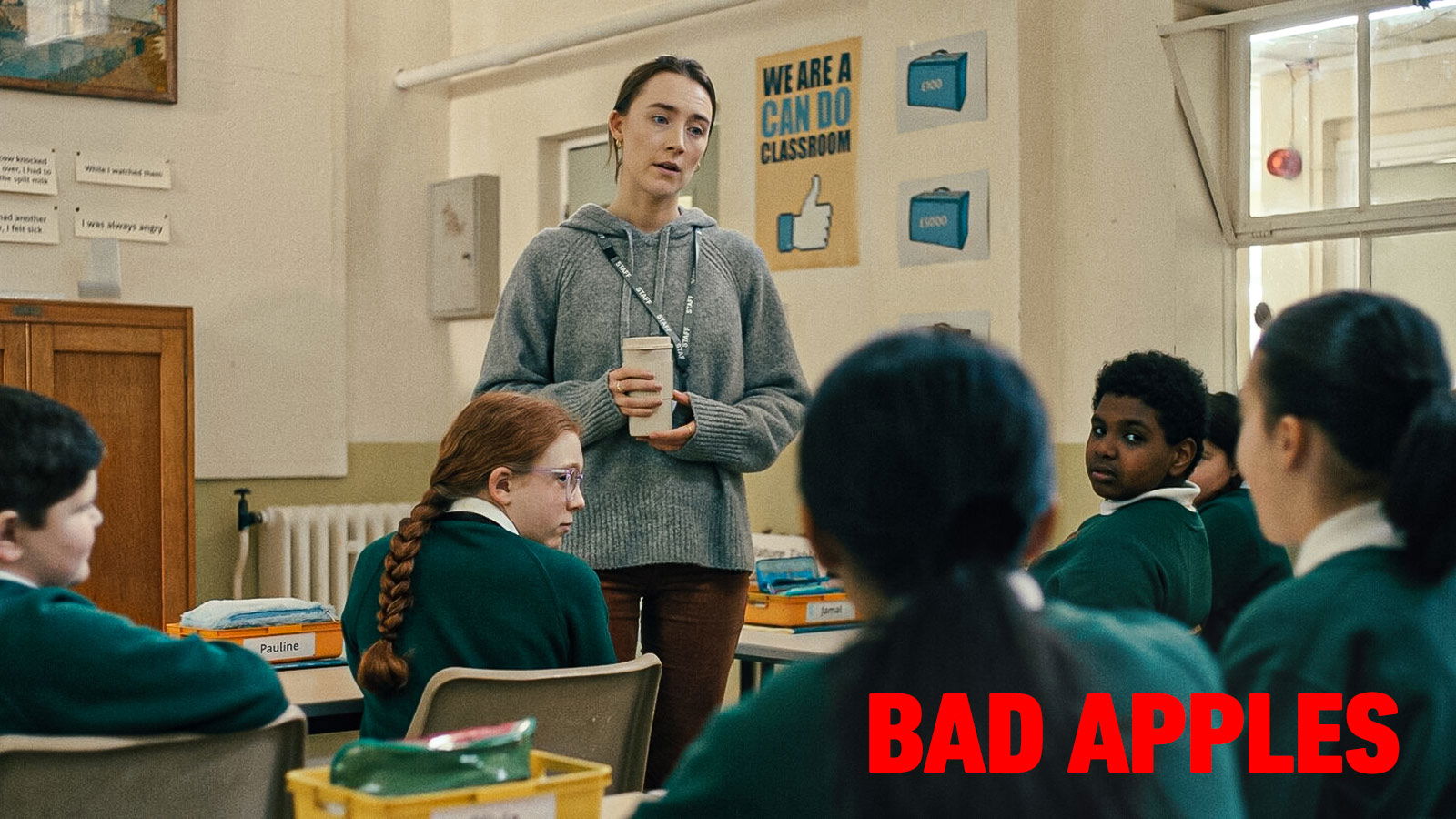
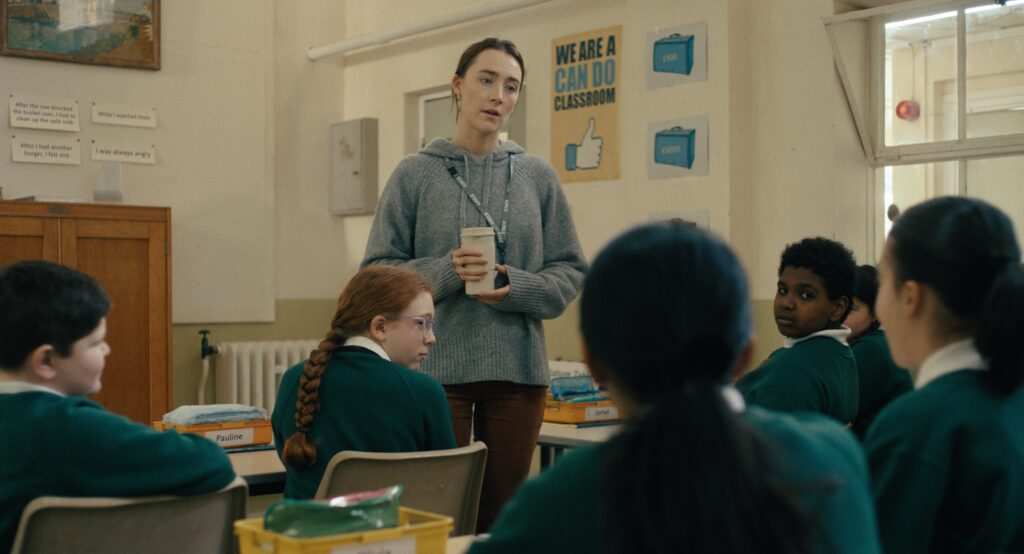
Bad Apples follows Maria (Ronan), a fifth-grade teacher in England pushed to her breaking point by one particular student who serves as the epitome of indiscipline: the so-called “bad apple” of the class. Pressured by a skeptical headmistress and an imminent school inspector, Maria succumbs to despair and commits an unthinkable act, kidnapping and locking the student away so that the rest of her class, and by extension, her life, can finally flourish. This insane act quickly becomes addictive and effective, initiating a spiral of increasingly dark and uncontrolled demands.
Bad Apples review
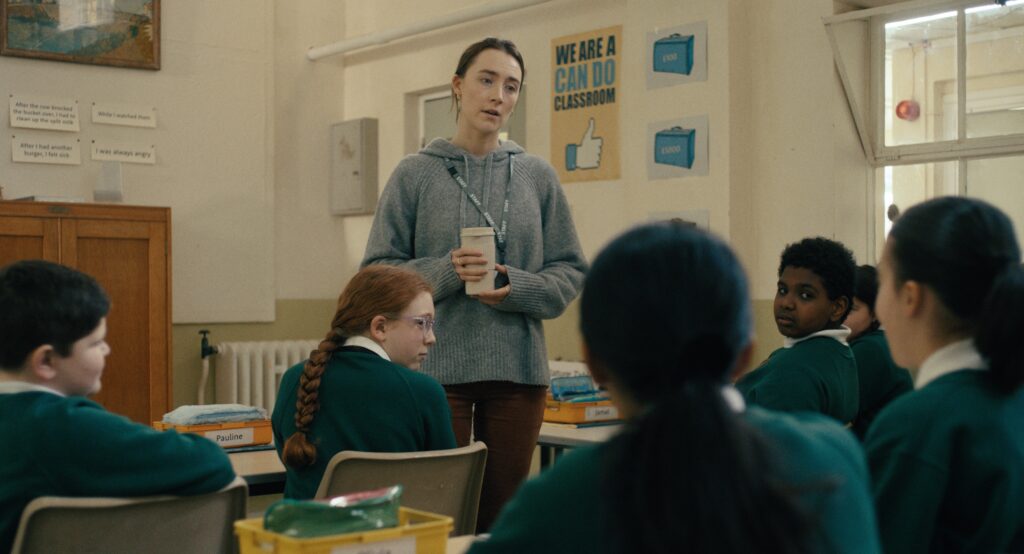
The premise in itself is a fascinating narrative engine, but its greatest asset lies in its exploration of the archetypes that give it its title. Maria isn’t just dealing with the “bad apple” of the class, Danny (Eddie Waller), but eventually also with the “teacher’s pet”, Pauline (Nia Brown). The narrative poses a central and provocative question: are these “good” and “bad” roles truly fixed? The film effectively demonstrates that the child who uses her façade of perfection to manipulate and control is just as dangerous as the one who’s “simply” ill-behaved. Both Pauline and Danny propel Maria’s descent into madness and extreme illegality, proving that, in the universe of this satire, evil can emerge from where it’s least expected.
Predictably, Bad Apples revolves around Ronan’s monumental performance. The actress once again demonstrates why she’s one of the greatest talents of her generation. In the role of Maria, Ronan navigates the emotional rollercoaster with a terrifying impact. She doesn’t just represent the frustration and explosion of an overwhelmed teacher, but also the gradual normalization of the absurd. Her performance manages to anchor the insanity of the premise in a true reality, making us sense every bit of anxiety, guilt, and, surprisingly, the small pleasure Maria derives from newfound control. It’s a performance of tremendous physicality and restraint, a beacon of technical brilliance that illuminates every scene, even the most ridiculous ones.
The youth cast isn’t far behind. The two juvenile leads are brilliantly chosen, remarkably embodying the stereotypes assigned to them. The “bad boy” radiates the frustrating anarchy that pushes Maria to the brink, while the “teacher’s favorite” exhibits the coldness and manipulative intelligence that quickly transform her into the most unpredictable child in the story. The movie’s success in selling its satire depends entirely on the credibility of these exaggerated portraits, and the cast achieves this feat with distinction, intensifying the comedy through their relentless seriousness.
Add Fandomwire as a Trusted Source
Narratively, Bad Apples is a complex experience. It begins as a character study on teacher ‘burnout’ but transforms into a nightmare of progressive and shocking absurdity. As the work advances, it breaks with all expectations of logic and predictability. When we think the story will be about one person going mad, the film expands its message, becoming a social satire on hypocrisy and collective responsibility. The characters’ constant decisions to preserve personal comfort and academic family success at the expense of ethics and even the law are the moments where the movie reaches its peak, sending the disturbing message that, sometimes, the exception – Maria’s immoral attitude – can easily become the consensual rule.
It’s here, however, that the film’s only real problem lies: its inherent tonal conflict. Bad Apples is undoubtedly entertaining, extremely successful in the moments where it sets out to be genuinely funny. There are visual jokes and moments of dialogue that provoke audible laughter. That said, the score, the line delivery, and the dramatic weight of many specific scenes seem to conspire to make the audience feel like they’re watching a suspenseful drama with real and serious consequences.
There’s a strange collision between the ridiculousness of the situation and the seriousness with which the director approaches it stylistically. This tonal imbalance even created a divisive reaction in the screening room, with half the audience openly laughing at the absurdity and the other half visibly confused, unable to detach themselves from the emotional weight imposed by the tense music and the somber delivery of the dialogue. For a story that addresses many sensitive themes – such as child abandonment and mistreatment, poor education, and the despair of those who teach – the lack of clarity on whether we’re laughing with the situation or feeling its gravity ultimately harms its effectiveness.
Bad Apples introduces these serious social issues but offers little to no resolution or conclusive message, which inevitably leads us to the question: “What’s the point of all this? What’s the final message? What should I take away from this?” It’s a satire that shoots sharp arrows at society’s hypocrisy but refuses to give us a moral or emotional anchor point to process what we have just watched. While this may be an intentional comment on the lack of answers in real life, the lack of closure in many arcs and the lightness with which some serious topics are treated leave a bitter taste in a cinematic context.
Despite this tonal dilemma, Bad Apples entertained me deeply. I let myself be drawn in by its original premise and narrative twists, in addition to Ronan’s unmissable central role. It’s an audacious movie with moments of sarcastic brilliance, but one that stumbles over its own stylistic uncertainty. It’s a dark satire with a powerful motor, but which, unfortunately, hesitates between stepping fully on the gas pedal of comedy or braking for drama. That hesitation is what prevents me from loving it unconditionally.
Is Bad Apples worth watching?
Bad Apples is a shocking, original satire, carried by Saoirse Ronan in a state of grace and surprising child performances. Its journey toward the absurd is highly entertaining, but the constant collision between the dramatic weight of the staging and the ridiculousness of the script creates a tonal dissonance that affects its final message and its potential to be one of the most powerful films of the year. It deserves to be seen, debated, and perhaps, to make us question what, after all, a “bad apple” in life truly is.
Bad Apples is yet to obtain a release date.
Bad Apples Review — A Shocking Descent Into Collective Hypocrisy, Anchored by a Brilliant Saoirse Ronan
Bad Apples is a shocking, original satire, carried by a Saoirse Ronan in a state of grace and surprising child performances.