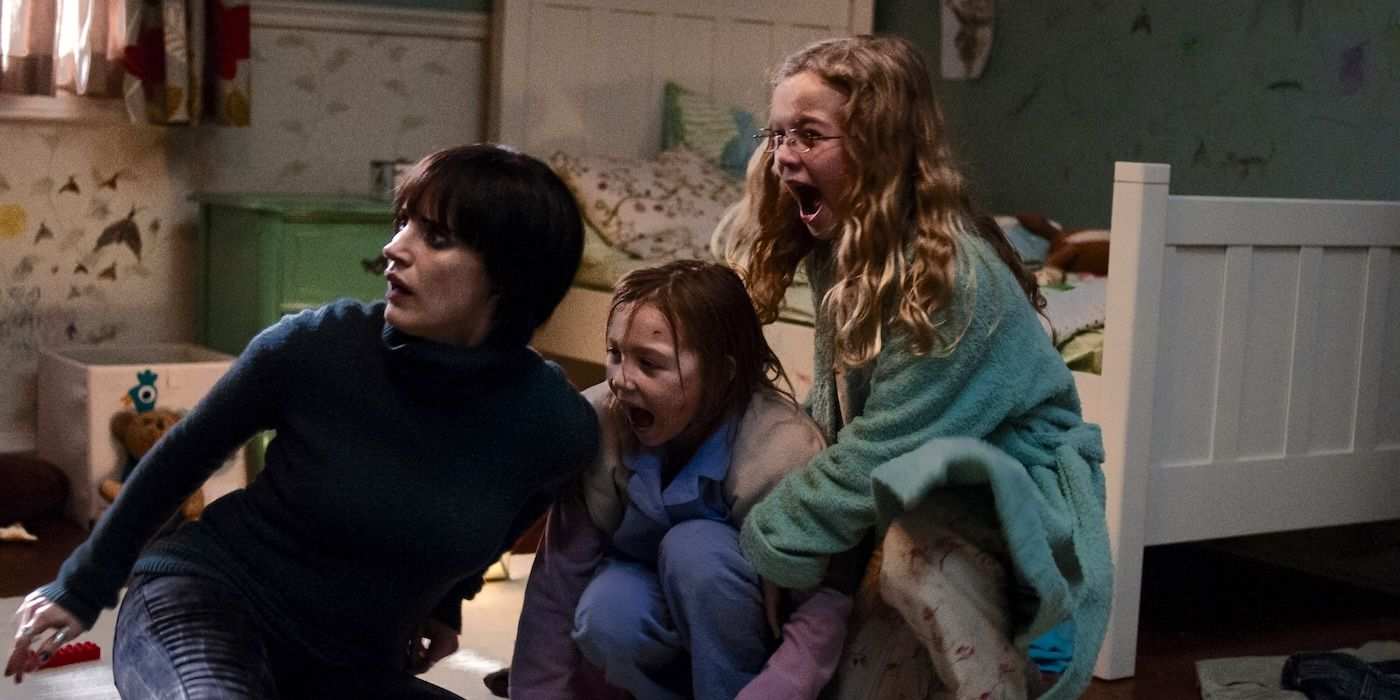
Before Andy Muschietti was handed Stephen King’s most infamous monster for revival, he proved that horror doesn’t need scale to be unforgettable with his 2013 feature debut, Mama. Backed by Guillermo del Toro, who served as an executive producer, the film is a deeply unsettling ghost story with a rotten heart beating beneath its chilling set pieces. Below its scares lies a story about the corrosive power of love and loss — a thematic throughline Muschietti would later bring to It and It Chapter Two. Mama didn’t just scare audiences in 2013; it announced a new voice in horror. The story of two feral girls and the vengeful spirit that clings to them isn’t just an effective supernatural horror movie but a blueprint for Muschietti’s signature blend of raw emotion and genre spectacle. Unlike so many ghost stories of its era, Mama doesn’t rely on relentless jump scares or cheap shocks. Its horror emerges from its emotional core — a mother’s love that morphs into something toxic and all-consuming.
With the first episode of Muschietti’s prequel series, It: Welcome to Derry, now out, Mama is essential viewing for how it offers an early glimpse into the kind of filmmaker Muschietti would become. It’s a little messy, undeniably ambitious, and unnervingly tender. It introduces a storyteller who seems to understand that horror often works best when it breaks your heart. For anyone who’s ever wondered how Muschietti earned the keys to one of the most iconic horror franchises in history, it all starts with a grieving ghost and a broken family.
A Ghost Story That Feels Like a Fairytale Gone Rotten
Mama begins like a dark fairytale (the del Toro effect). Two little girls are abandoned in a cabin deep in the woods, and instead of dying, they are taken in by something that isn’t quite human. Years later, when they’re discovered and returned to civilization, that “something” comes with them. This setup is familiar enough — a spirit that refuses to let go — but Muschietti’s treatment is what elevates it. Mama is steeped in a gothic atmosphere, but it’s less focused on a haunted house and more on the people caught in the haunting. The entity at the center of the film, known to the girls as Mama, isn’t an arbitrary monster. She’s a grieving woman from another century, a maternal figure warped by tragedy into something monstrous. Her love is possessive, suffocating, and terrifying. Instead of positioning the ghost as an external threat, Muschietti roots the horror in emotional attachment: What makes Mama so terrifying is that she doesn’t want to hurt the girls — she wants to keep them.
The film plays with visual language that feels ripped from a children’s storybook: winding forests, shadowy corridors, and a creature that moves like a twisted mother figure out of a cautionary tale. Mama’s long, insect-like movements — rendered through an eerie blend of CGI and physical performance — are deeply unnatural, yet they’re always paired with a tragic undertone. It’s a reminder that Muschietti’s horror has always been about the tension between terror and tenderness. Mama embodies the kind of horror Muschietti would later perfect: something that’s frightening not because it’s alien, but because it reflects our most primal emotional bonds — love, grief, family — and twists them until they break.
Guillermo del Toro’s Eye for the Macabre Was the Catalyst
Del Toro has an uncanny ability to spot filmmakers who see horror as something more than jump scares. When he saw Muschietti’s short film of the same name that Mama is based on, he recognized not just a creepy ghost story but a fully formed sensibility. Del Toro came on as a producer for the feature-length adaptation, lending both his creative guidance and the industry weight that ensured the project wouldn’t be buried as a low-budget genre flick. Del Toro’s career has long balanced beauty and brutality — from The Devil’s Backbone to Pan’s Labyrinth — and he understood the fairy tale darkness that ran through Muschietti’s story. Under his wing, Mama leaned into its weirder instincts rather than sanding them down. The ghost wasn’t softened, and the ending wasn’t forced into a neat resolution. It was allowed to be mournful, strange, and upsetting.
That tone — tragic but not sentimental — is a hallmark of both filmmakers. Del Toro’s presence also gave Muschietti a platform most first-time horror directors never get: visibility. When Mama hit theaters in January 2013, it got noticed immediately and was a box office hit, earning over $146 million at the global box office off a budget of just $15 million. Hollywood took note of the emotional intelligence behind the scares. And when the time came to reboot one of the most iconic horror properties in history, Muschietti was on the shortlist.
Mama’s Emotional Core Became the Foundation for ‘It’
What separates Mama from the pack isn’t just its spectral imagery or its jump scares — it’s the way Muschietti uses horror to explore emotional trauma, similar to his It films. Pennywise may be terrifying, but what really drives those films is the fractures in the Losers Club’s lives: grief, abuse, guilt, loneliness. It’s the same narrative DNA as Mama’s story, scaled up to blockbuster size. The two feral girls in Mama are survivors of unimaginable neglect, clinging to the only figure who’s cared for them — even if that figure is a ghost. Their adoptive parents, played by Jessica Chastain and Nikolaj Coster-Waldau, have to navigate not just the haunting but the emotional wreckage the girls carry with them. It’s this kind of layered storytelling — where the human wounds are more unsettling than the supernatural ones — that became Muschietti’s calling card.
When you look closely, Mama and It are narratively connected by their fascination with how trauma binds people together. Mama clings to the girls just as Pennywise preys on the Losers’ shared fears. Both stories hinge on the danger of looking away from pain, of pretending the past isn’t still breathing down your neck. The horror isn’t “defeated” so much as lived with — a lingering presence that shapes everyone left standing. Mama may not have had the scope or budget of It, but thematically, they share the same beating heart.
A lot of ghost stories from the early 2010s have faded into the streaming ether, but Mama hasn’t. That’s because Mama still feels different. It doesn’t chase trend-chasing horror formulas or offer up disposable scares; it lingers. The film’s design, from its muted color palette to Mama’s grotesque silhouette, feels distinct. It exists at the intersection of a gothic fairytale and a modern supernatural thriller. And its final act is one of the rare horror climaxes that leaves an emotional bruise rather than just an adrenaline spike. Mama also stands as a snapshot of a filmmaker at the beginning of something massive. Muschietti has since helmed two of the highest-grossing horror films of all time with It and It Chapter Two, and stepped into the world of DC blockbusters with The Flash. But the DNA of Mama is still there: the fusion of intimacy and spectacle, the conviction that horror works best when it’s rooted in something deeply human.

- Release Date
-
February 21, 2013
- Runtime
-
100 Minutes