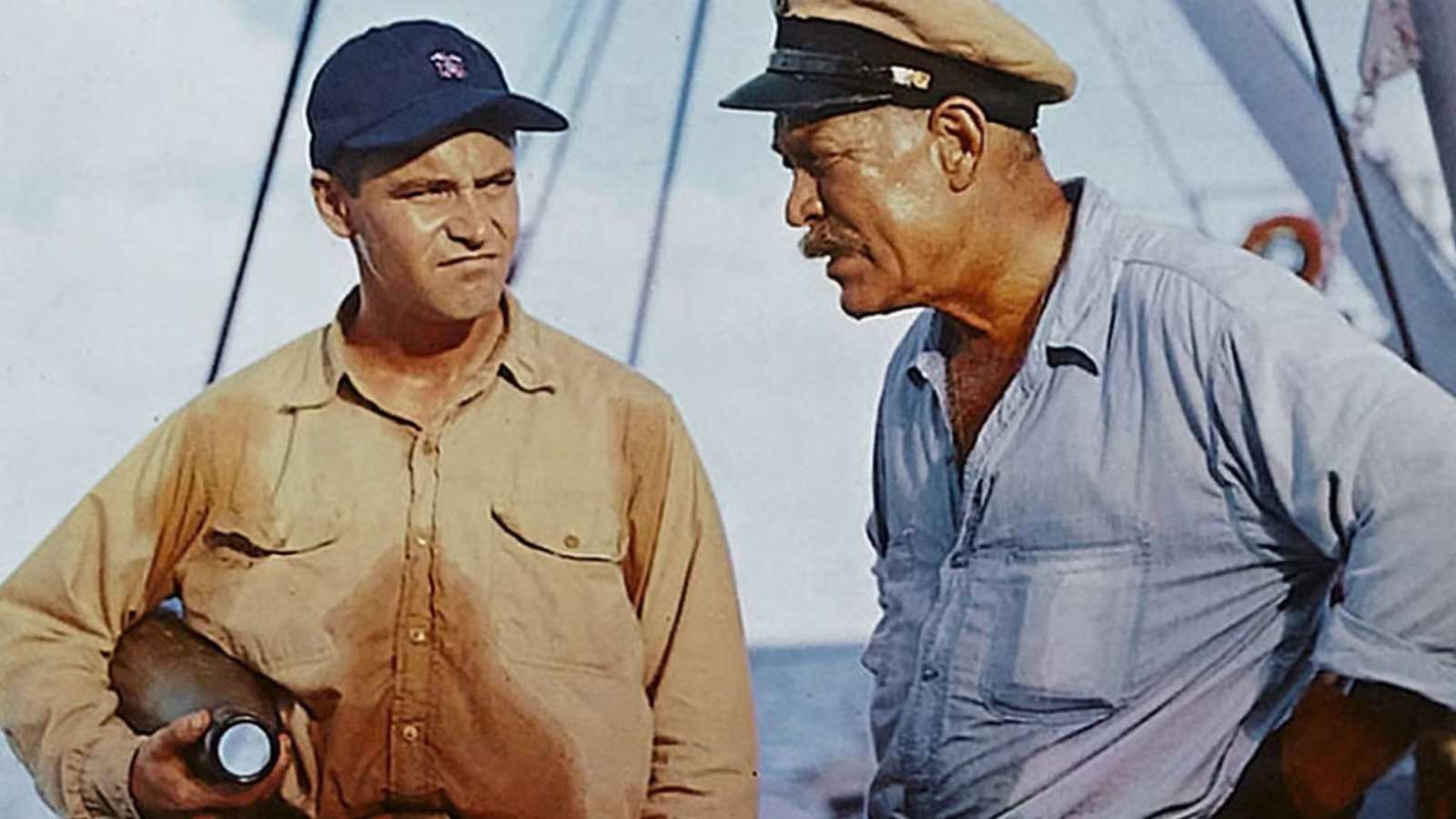
John Ford is best known for Westerns, but he is also one of the better war movie directors of his generation. Not only was John Ford a great director, but he was also a veteran who left Hollywood to serve in World War II as a commander in the United States Navy Reserve. While enlisted, Ford directed U.S. propaganda films.
When he got out of the military, he had a more cynical eye toward war movies. He directed war movies that offered a pessimistic view of war, while also presenting a different perspective on the American West, including the American Civil War. Added to his Westerns, it solidified John Ford’s role as a master director.
10
Four Sons (1928)

Released in 1928, Four Sons was an early John Ford war movie. It was not technically a silent movie because, although there was no dialogue, it did have a synchronized musical score. Interestingly, John Wayne was in the film in a very early uncredited role as a military officer, over a decade before his breakout in Stagecoach.
The film follows a family in Bavaria whose lives are torn apart during World War I. This is because one of the sons had moved to America and eventually enlisted with the A.E.F., while his three brothers, still in Bavaria, were conscripted into the German Army. The film focuses on the cruelty of the war on the families left behind.
Four Sons is one of the few movies that John Ford made between 1917 and 1928 that survived, and it was preserved in the Academy Film Archive in 1999. There was also a remake in 1940, although John Ford had nothing to do with it.
9
The Lost Patrol (1934)

The Lost Patrol was released in 1934 and was based on Philip MacDonald’s novel of the same name. This was a John Ford pre-Code war film that tells the story of a British mounted patrol in the Mesopotamian desert. When a sniper kills their lieutenant in charge, the patrol doesn’t know what their mission is and remains lost.
The cast is impressive, with Boris Karloff, best known for playing Frankenstein’s Monster, in a rare non-horror role. Wallace Ford, Victor McLaglen, and Reginald Denny also provided familiar faces from the era. Critics called The Lost Patrol a flawed masterpiece, but it still influenced many war movies that followed it in the 1930s.
The movie was also nominated for an Oscar for Original Music Score. Its Rotten Tomatoes score is a perfect 100% – and for good reason.
8
Pilgrimage (1933)

Released in 1933, Pilgrimage is another pre-Code John Ford war film. However, this one failed to impress critics at the time of its release. The storyline was problematic. An Arkansas mother, Mrs. Hannah Jessop (Henrietta Crosman), doesn’t want her son to marry the woman he loves, so she arranges for him to enlist in the Army during World War I.
Of all his movies from the early 1930s, this might be the one most reflective of John Ford’s work, and it is possibly one of the best-looking movies he made during that era. As expected with a movie where a mother would rather her son fight in World War I rather than marry a woman he loves, this ends in tragedy.
This plays well as a film to watch along with Four Sons. While Four Sons sees a mother watch her sons die in a war, Pilgrimage sees a mother mourn her son after forcing him into battle. While Four Sons saw the mother find comfort in her surviving son, Mrs. Jessop found no such comfort or peace.
7
Rio Grande (1950)

In 1950, John Ford and John Wayne teamed up for Rio Grande. This was the third part in the Cavalry Trilogy of John Ford movies, following Fort Apache and She Wore a Yellow Ribbon. What is interesting is that Ford didn’t want to make this movie, but had to for the studio to let him direct The Quiet Man.
Regardless of the reason he made it, Rio Grande remains a great Western war movie, with John Wayne starring as a military man posted on the Texas frontier who finds that his estranged son, Jeff, is one of his latest recruits. The film also stars one of Wayne’s greatest co-stars, Maureen O’Hara, as his estranged wife.
While it doesn’t quite match up to the other two Cavalry Trilogy movies, Rio Grande is still a good Western in its own right, although it lacked much of the depth of storytelling of other John Ford collaborations with John Wayne.
6
The Long Voyage Home (1940)

Released in 1940, before John Ford left to fulfill his military service, The Long Voyage Home is based on a play written during World War I, but Ford repurposed the story for the early days of World War II. The story follows a British tramp steamer on the voyage home from the West Indies during World War II.
What really makes this movie stand out is how John Ford shot it, which differed from the way he shot many of his Westerns and 1930s movies. This was filmed in a more distinctive manner, which many film scholars believe was a precursor to the film noir aesthetic that would become popular in the 1940s.
The movie flopped at release, thanks to its darker storyline and the lack of any possible romance for the leads. However, critics praised the story, with some comparing it favorably to The Odyssey. It has a 100% Rotten Tomatoes score and was nominated for six Oscars, including Outstanding Production for John Ford.
5
The Long Gray Line (1955)

The Lone Gray Line was a late-era John Ford war movie, released in 1955. The film is based on the life of Marty Maher, with Tyrone Power in the lead role. Marty Maher was an Irish immigrant who joined the United States Army in 1898 and rose to the rank of master sergeant.
While John Wayne was not in this John Ford movie, he did cast Maureen O’Hara to play Maher’s wife and fellow immigrant, Mary O’Donnell, and long-time collaborator Ward Bond to play Herman Koehler, the Master of the Sword, the West Point football coach who becomes his friend. Western legend Harry Carey Jr. also appears as Dwight D. Eisenhower.
The Long Gray Line was critically praised, with a 90% rating on Rotten Tomatoes, and it remains one of the best war movies to focus on training at West Point and similar facilities.
4
They Were Expendable (1945)

When John Ford finished his military service, he returned home and directed some movies that made him seem jaded by the experience. This was most evident in the war movie They Were Expendable, which starred Robert Montgomery and John Wayne. The film follows soldiers aboard a PT boat as they defend the Philippines against the Japanese invasion.
Ford directed the film based on the book by William Lindsay White, and John Ford had extensive support from the Navy when it came to making the movie. The credits even listed “Directed by John Ford, Captain U.S.N.R” and “Screenplay by Frank Wead Comdr. U.S.N., Ret.”
The movie was a box-office hit, but it still lost money due to its higher budget. It was also an Oscar favorite, nominated for Best Sound Recording and Best Effects.
3
Fort Apache (1948)

Fort Apache was the first movie in John Ford’s Cavalry Trilogy and was inspired by the James Warner Bellah story “Massacre.” This film stars Henry Fonda as a lieutenant colonel named Owen Thursday, who was based on the real-life historical figure George Armstrong Custer. When he is assigned to a new post, his arrogance clashes with Captain York (John Wayne).
The war movie is a tale of two soldiers, one egotistical and a man who refuses to listen to his men, and the other, someone who understands the enemy but has no power to save his men’s lives. It is a sobering tale of how one man’s arrogance can cost his entire regiment its lives in a misguided battle.
Fort Apache is also a parable of how even the worst soldiers can be made into heroes when the stories are finally written and the truth is covered up. It is also one of Ford’s first “pro-Native America” Western war movies. The AFI named this one of the best Western films of all time, with a 100% Rotten Tomatoes score.
2
Mister Roberts (1955)

Released in 1955, Mister Roberts was a comedy-drama war movie that featured an incredible cast, led by Henry Fonda, James Cagney, William Powell, and Jack Lemmon. Based on the novel and Broadway play of the same name, the movie follows a Navy cargo ship in the Pacific Ocean during the final days of World War II.
Henry Fonda plays an executive officer on the ship, while serving under the cruel captain, Lt. Morton (James Cagney). This war movie is not about battling the enemy. Instead, it is about one soldier who does everything in his power to be a good one, despite his own captain being antagonistic and cruel every step of the way.
Mister Roberts was nominated for three Oscars, including Best Picture, Best Sound, and Best Supporting Actor, with Jack Lemmon winning that last award. On top of the Oscar success, Mister Roberts also has a 93% “fresh” rating on Rotten Tomatoes, with critics praising it as a “bittersweet film” about a soldier and the crew who look up to him.
1
She Wore a Yellow Ribbon (1949)

The second movie in the Cavalry Trilogy is also the best war movie that John Ford ever directed. She Wore a Yellow Ribbon was so beloved and respected that General Douglas MacArthur said he watched it every month. John Wayne starred as a soldier named Captain Brittles on the night of his retirement.
He gets one last order and one final mission before he can hang it up. Brittles is ordered, and not given a choice in the matter, to put his retirement on hold until he can ride into hostile territory to stop a possible new Indian War following the massacre of George Custer’s troops at the Battle of the Little Bighorn.
This continued John Ford’s shift in storytelling, presenting Native American tribes in a positive light. Brittles went to negotiate peace and end further fighting, and he grew close to the Native Americans he encountered. Of all John Ford’s war movies, this was a clear sign that he wanted to show peace amid war, making it one of his best.