Historical movies aren’t just about recreating events but about feeling their emotional gravity. It’s one thing to learn about history and quite a different one to understand it. The best movies in this genre immerse us in their setting and situations rather than just informing, showing us what it meant to the people who lived it.
With this in mind, this list looks at the most powerful period movies of all time and ranks them based on their effectiveness and impact. The ten titles below span a range of places and eras, but each brings a particular moment or event to breathtaking life, helping us feel the frightening weight of real lives shaped by fate and power.
10
‘Doctor Zhivago’ (1965)

“Someday you’ll grow up and you’ll know that life isn’t like that. It’s never like that.” A sweeping epic of love, loss, and revolution. Directed by the inimitable David Lean, the protagonist (Omar Sharif) of Doctor Zhivago is a poet-physician swept into the turmoil of the Russian Revolution and torn between passion and duty. Opposite him, Julie Christie’s Lara becomes the embodiment of yearning amid political upheaval. Their intertwined stories, set against a vivid backdrop of social transformation, blend heartbreak and vast historical ruin.
Lean paints the revolution not as triumph, but as a slow erasure of humanity, where ideals harden into tyranny and ordinary people pay the price. Doctor Zhivago is no hagiography; the emotions are larger than life, and the setpieces are all grand, as one would expect from the director. He immerses the viewer with evocative ideas and aesthetics, including the balalaika score, the frozen vistas, and, of course, the doomed lovers at the eye of the storm.
9
‘The King’s Speech’ (2010)

“I have a voice!” Leadership doesn’t always look like glory; sometimes it’s just a man trembling before a microphone. In The King’s Speech, Colin Firth gives an extraordinary performance as King George VI, a prince unexpectedly thrust onto the throne. As World War II breaks out, the inexperienced monarch must overcome a debilitating stutter to rally Britain against the rise of fascism. Firth is joined by a cast of British heavy hitters, including Helena Bonham Carter as his wife Elizabeth and Geoffrey Rush as the witty, unorthodox speech therapist who becomes his closest ally.
The stakes are quiet but enormous. Not battles or bloodshed, but dignity and courage forged in the privacy of struggle. In its most moving scenes, a monarch becomes human, a nation finds strength in humility, and the idea of leadership shifts from power to sacrifice. Tom Hooper succeeds in making an interior struggle feel epic and compelling, which is no small feat.
8
‘Lincoln’ (2012)

“Do you think we choose to be born? Or are we fitted to the times we’re born into?” Rather than delivering the war movie one might have expected, Spielberg crafts Lincoln into a political drama about one of the most consequential pieces of legislation in American history: the 13th Amendment. Tony Kushner’s screenplay turns politics into moral combat, where compromise and idealism collide under crushing stakes. In the lead role, Daniel Day-Lewis delivers a performance of staggering nuance, portraying Abraham Lincoln not as a monument or demigod but as a man: worn, witty, haunted, and relentless.
Here, history is a process, not a pageant, a reminder that profound change is forged in backrooms, debates, and personal sacrifice. The film’s power lies not in spectacle, but in quiet conviction, the belief that justice must be built brick by brick, even in the face of impossible odds. It’s one of the very best movies about a painful but crucial chapter in the country’s story.
7
‘Darkest Hour’ (2017)

“You cannot reason with a tiger when your head is in its mouth!” In Darkest Hour, Gary Oldman, nearly unrecognizable as Winston Churchill, channels the weight of a nation on the brink of collapse. Britain stands alone against Hitler; defeat whispers from every corner; Parliament doubts its leader; and Churchill’s resolve becomes civilization’s last thread. Joe Wright’s filmmaking is theatrical and propulsive, filled with smoky war rooms, desperate phone calls, and trains rumbling toward history.
But the movie’s beating heart is the terror behind Churchill’s bravado, the man who must project certainty while drowning in doubt. He faces political plots to take him out, along with his uncertainty about whether to negotiate with Hitler or take a (potentially doomed) stand against him. All this tension culminates in the Prime Minister’s legendary “We shall never surrender” speech. A raft of crackpot YouTube “historians” have recently suggested that Churchill was a villain rather than a hero. This film definitely rebukes them.
6
‘Lawrence of Arabia’ (1962)

“The trick, William Potter, is not minding that it hurts.” Another masterpiece from David Lean and one of cinema’s cornerstones. Lawrence of Arabia transforms history into legend and legend into a psychological labyrinth. Peter O’Toole’s T.E. Lawrence is both hero and enigma, a man who leads Arab tribes against the Ottoman Empire while battling his identity and desires. His story unfolds across endless dunes and impossible horizons, where ambition burns hotter than the sun.
The movie works as both a celebration of daring and a critique of imperial delusion. It’s an odyssey of self-invention that becomes self-destruction. The score, the mirages, and the shimmering heat all become metaphors for a man consumed by destiny. Fundamentally, it asks whether greatness is triumph or just tragedy disguised as glory. Lawrence of Arabia is visually inventive too, boasting perhaps the most iconic match cut of all time. Countless filmmakers to come would borrow from its playbook.
5
‘Schindler’s List’ (1993)

“Whoever saves one life, saves the world entire.” Few films confront horror with such solemn clarity. Here, Spielberg tells the true story of Oskar Schindler, a flawed industrialist who saved over a thousand Jews during the Holocaust. Liam Neeson, Ben Kingsley, and Ralph Fiennes all deliver phenomenal performances, the latter playing a character that makes Voldemort look practically chummy. On the aesthetic side, Janusz Kamiński’s stark black-and-white cinematography communicates the moral stakes, broken only by the red of a young girl’s coat.
More than simply a great film, Schindler’s List is an important one. It’s an act of witness that engages honestly with suffering, then finds fragile redemption in a man discovering humanity at the edge of darkness. Its best moments are genuinely profound and affecting, including the trembling hands and the final graveside scene. A challenging story to tell, but one Spielberg handles with maturity and grace.
4
‘12 Years a Slave’ (2013)

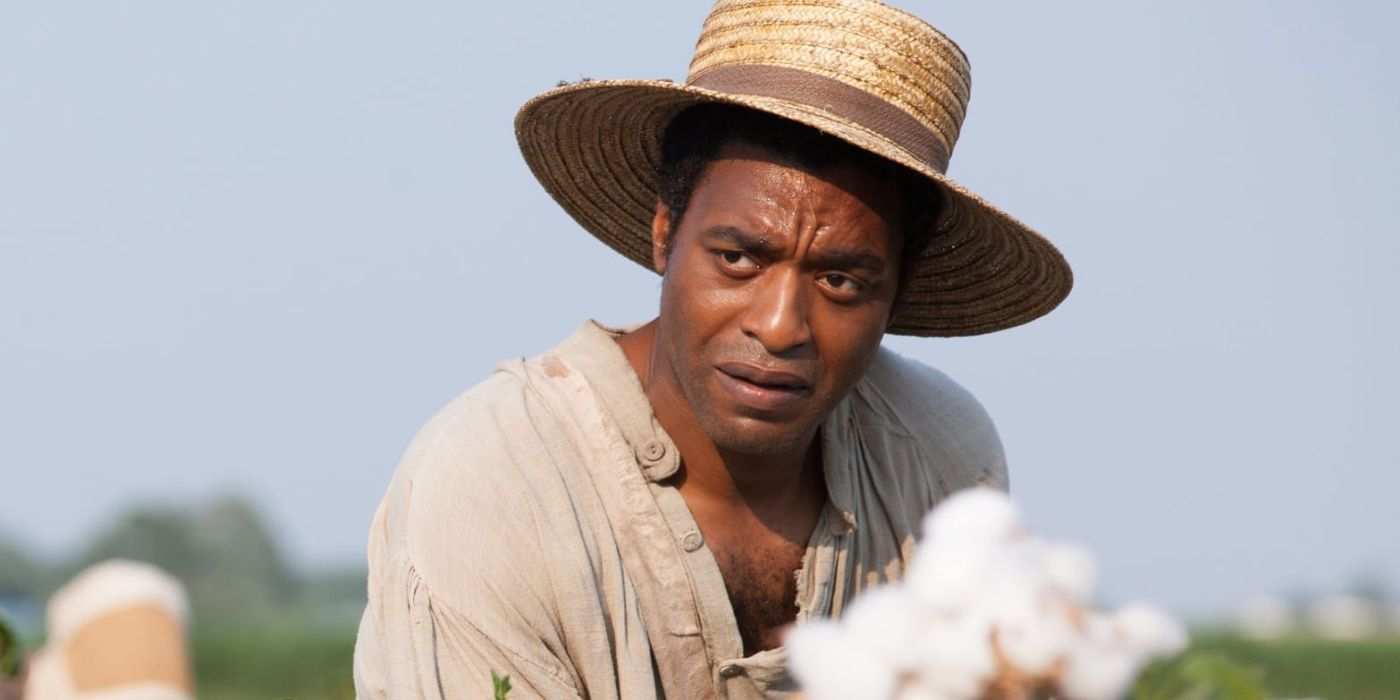
“I don’t want to survive. I want to live.” Steve McQueen adapts Solomon Northup’s memoir into a raw, unflinching testimony that dismantles romantic myths of American history. Chiwetel Ejiofor‘s lead performance is quiet but volcanic: a free man kidnapped into slavery, enduring brutality with dignity that cannot be erased. Alongside him, Michael Fassbender, Sarah Paulson, and an Oscar-winning Lupita Nyong’o turn in performances that sear the soul, each embodying facets of cruelty and survival.
McQueen refuses comfort, sentimentality, or cinematic distance. In doing so, 12 Years a Slave forces history to speak plainly, demanding reflection instead of catharsis. Suffering is not abstract or symbolic here, but personal, immediate, and real. The film’s power comes not from violence, but from truth: at first denied, then reclaimed, and finally remembered. Not for nothing, 12 Years a Slave has since been ranked by several polls as one of the best movies not just of the 2010s but of all time.
3
‘Gladiator’ (2000)
“What we do in life echoes in eternity.” Gladiator resurrected the historical epic with thunder and tears. Russell Crowe commands the screen as Maximus, a betrayed Roman general turned slave who rises through the arena to challenge tyranny. In telling his story, Ridley Scott blends historical myth with Shakespearean emotion. He gives us sand soaked in blood, senators whispering in marble halls, and Joaquin Phoenix coiled and venomous as Emperor Commodus.
In this brutal vision, justice is pursued through sweat, loyalty, and unbreakable spirit. Gladiator gave the epic genre back its pulse, reminding audiences that spectacle matters most when anchored to heartbreak. The film’s emotional core isn’t revenge, but devotion: to family, to honor, to a Rome that could be better. “Are you not entertained?” Yes, but more importantly, you are moved by the sight of a warrior walking into the afterlife’s golden fields. It’s a lesson the sequel would not understand half as well.
2
‘Dunkirk’ (2017)

“Survival is not fair.” Christopher Nolan brings one of WWII’s direst moments to vivid life, all fragmented time, pounding waves, and desperate breath. Instead of speeches or biographies, the film offers immersion. We get soldiers trapped on a beach, pilots racing against fuel and fate, and civilians crossing the channel in fragile boats. Rather than being a dry history lesson, Nolan renders that moment as pure sensation. He plunges us into the scene to really feel the fear and hope.
Without traditional character arcs, the soldiers become universal. The fear of drowning, burning, or being forgotten becomes ours. The emotional payoff arrives not in victory, but in the miracle of unlikely survival. In other words, Dunkirk strips war of romance and reveals its essence: endurance, duty, and the quiet heroism of ordinary people refusing to let one another drown. Visually striking, narratively inventive, emotionally intense, it is perhaps the finest war movie of its decade.
1
‘Saving Private Ryan’ (1998)

“Earn this.” Spielberg strikes again. He opens Saving Private Ryan with the Omaha Beach landing: chaotic, deafening, merciless. In the process, he changed war cinema forever. Tom Hanks leads a squad tasked with an impossible mission: find one soldier (Matt Damon) so his family won’t lose all their sons. The story is simple, but the execution is mythic. The movie blends propulsive action and gut-wrenching realism with moral questioning. What is one life worth against many?
Through mud, fear, brotherhood, and sacrifice, the film pays tribute to every soldier who never came home. What makes it powerful isn’t just the brutality, but the humanity inside it, which comes across in the jokes whispered between brothers in arms, the shaking hands, the moments of grace against a backdrop of carnage. Ultimately, there’s something hopeful and pure at the heart of the movie, making it simultaneously one of the most harrowing and uplifting war movies ever made.