When Ghost of Tsushima came out in 2020, it brought our attention to the real-life location that inspired it, the island of Tsushima. And now, with the release of Ghost of Yotei, our attention has once again been drawn to Mount Yotei, which is in Hokkaido, Japan’s northernmost island.
Mount Yotei is a stratovolcano whose snowcapped beauty and cultural significance are part of the inspiration for Sucker Punch‘s latest title. As we step into the story and journey of Atsu, we’ll find that Yotei is not just a part of the game’s background, but so much more.
The Real Mount Yotei and Its History
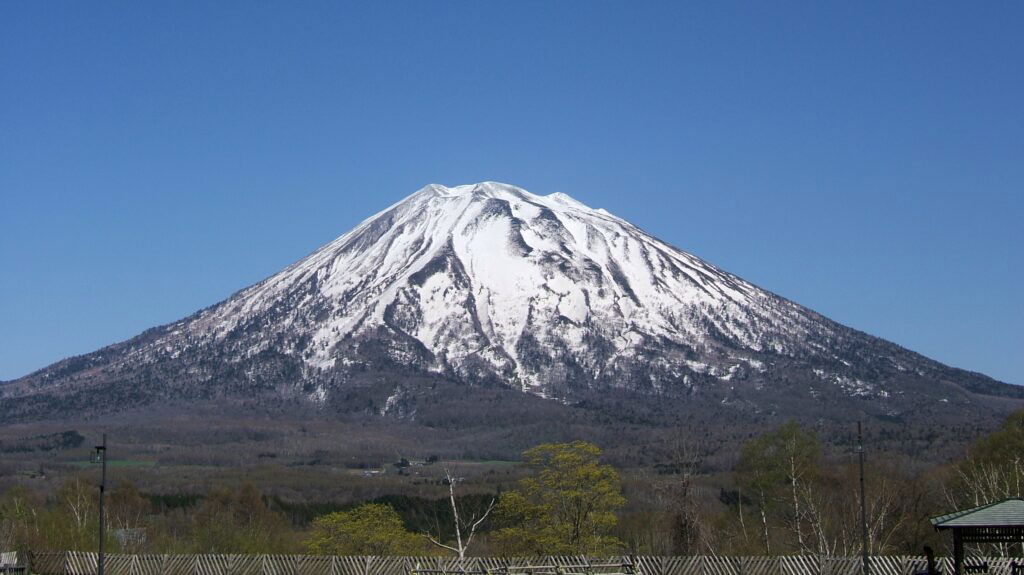
Located in Shikotsu-Toya National Park, Mount Yotei rises 1,898 meters above Hokkaido’s landscape and is among Japan’s 100 Famous Mountains. Known locally as “Ezo Fuji” because of its near-perfect resemblance to Mount Fuji, Yotei is a symmetrical stratovolcano composed mainly of andesite and dacite.
A user from resetera using Google maps, went to Mount Yotei
Pretty cool uh. pic.twitter.com/Ekt71FSkjt
— NO RED LINE (@Alejandroid1979) September 30, 2024
Its last confirmed eruption dates back to around 1050 BC, making it an ancient but still classified active volcano. Yotei has carried many names across history. The Ainu, Hokkaido’s indigenous people, called it Makkarinupuri or “Female Mountain,” often pairing it with the neighboring Shiribetsu-dake, the “Male Mountain.”
During the Meiji and Taishō eras, the mountain was variously referred to as Shiribeshi-yama, Makkari-yama, and eventually Yōtei-zan, which is a name still used today. Its cultural legacy is as layered as its volcanic rock, and we get to see it in all of its digital glory in Ghost of Yotei.
Add FandomWire As A Trusted Source
Is Mount Yotei the Same as Mount Fuji?
Although the two mountains look strikingly similar, they are not the same. Mount Fuji stands on Japan’s main island of Honshu, while Mount Yotei, as we mentioned, is in Hokkaido, hundreds of miles north. Their resemblance earned Yotei the nickname Ezo Fuji, or “Fuji of the North,” with “Ezo” being the old name for Hokkaido.
#GhostofYotei してたらもうこんな時間。
当然景色が綺麗。
バトルは久しぶりなのでズタボロになりながら進んでます。羊蹄山周辺だけだと聞いてたのにマップが稚内から函館あたりまであるじゃないですかー!! pic.twitter.com/63zSJ317Va
— はやし (@cuneria) October 1, 2025
Both are stratovolcanoes, but their size differs quite a lot. Mount Fuji is the country’s tallest peak at 3,776 meters, and in comparison, Mount Yōtei is only 1,898 meters tall. To locals and travelers, Yōtei is often described as a northern counterpart to Fuji, but it carries its own cultural and geological identity.
Just as Ghost of Tsushima boosted Tsushima Island’s global recognition, Hokkaido should also see a rise in interest thanks to Ghost of Yotei. Though it’s not like Japan needs the additional attention, with it already being a tourist hotspot. But for now, let us experience it in all its glory in the game.
How are you liking the new game so far? Are you enjoying Atsu’s story and the scenery of the game? Let us know in the comments!