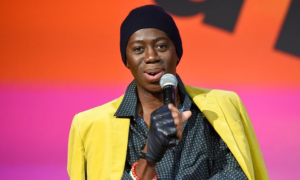
For their latest album Dream Ride, singer-songwriter and multi-instrumentalist G Flip is going totally ’80s, delivering a record full of soaring hooks, booming drums, and, yeah, maybe even a few sax-y solos here and there.
Dabbling in Butch Springsteen, Masculine Madonna, and everything in between, G’s been inspired by the sounds of the decade to craft a record full of pop-rock perfection that sounds timeless, yet with a modern twist.
How about we take this to the next level?
Subscribe to our newsletter for a refreshing cocktail (or mocktail) of LGBTQ+ entertainment and pop culture, served up with a side of eye-candy.
From the windows-down curise-ability of “In Another Life” to the floor-stomping bravado of “Big Ol’ Hammer,” the record is queer anthems after queer anthem—the kind we wish we’d grown up on. Coming of age in Australia, G didn’t see so much LGBTQ+ representation in pop culture, so they set out to right those wrongs themself with Dream Ride—even if that means they’d have to play every instrument to do so.
And with lyrics that not only fully embrace their nonbinary identity, but also play around with gender roles and take a defiant stance agains homophobia and hate, G Flip continues their ascendency into pop superstardom while being a shining beacon of hope for all the queer folks out there, giving us the permission to rock.
Before Dream Ride drops in record stores and on streaming platforms on September 5, we invited G Flip to the hot set or our long-running Q&A series, Dishin’ It. In our conversation, they open up about creating a persona & sonic world indebted to the ’80s, why they write most of their songs with a live audience in mind, and how their romance with Chrishell Stause continues to inspire the music, four weddings in!
Is there a piece of media—whether a movie, TV series, book, album, theater, video game, etc…—that has played an important role in your understanding of queerness and the queer community, or your own identity? Why does it stand out to you?
I feel like growing up there wasn’t much queer representation in media in Australia, there really wasn’t. I think one of the first artists I heard on Australian radio that used she/her pronouns for a queer relationship was an artist called Alex Lahey. And then, more recently, being a nonbinary person, some of the first nonbinary story lines or characters I saw were in Mae Martin’s series Feel Good—the scene where they’ve just gone to a vendor selling food on the street, and then they talk about pronouns and the feeling of being non binary, that was one of the first scenes I saw in media or TV that really took my breath away. I was like, “Oh my god, I’ve never seen anything like this.”
But to be honest, just growing up in Australia, there wasn’t much media. The characters that I aligned with in movies were always kind of male characters that I wanted to be like. And my favorite movie of all time—this is pretty silly—but it was Cars! I wanted to be Lightning McQueen and find my Sally. [Laughs.] But it’s so great now that there’s so much queerness in movies, TV, everything—it’s really awesome to see.
Congratulations on Dream Ride, which is so much fun—I love how unabashedly big and anthemic it is. What can you tell me about what you set out to achieve with this album, and how would you say it pushed or challenged you as an artist?
When you get to the point where you’re trying to find the new project or the new sound or the new thing, you’ve really just got to throw everything at the wall. So, I’ve got a studio in LA which is just filled with instruments—there’s just gear everywhere, because I’m a bit of a gear-head. And my collaborator, Aidan Hogg—we co-write and co-produce all the songs together and play all the instruments on the songs—we had about three months where we just threw everything at the wall every day. We tried to write three to four songs a day and just see where that took us.
When we made my last record, we were thinking of doing an ’80s vibe song, because the record was called Drummer and drums in the ’80s were very prominent—there was a big shift, and drums were getting closer to being at the front. And I really liked how they recorded drums back in the ’80s. So, my last album there was talk and discussions and some little recordings that were in the ’80s-esque world. But then we quickly realized, like, “Oh, this is its own thing!” Because it’s not just the drums in the ’80s—there’s so much musicality, there’s sax solos, synth solos, guitars, textures, nostalgic themes, drama, key changes. There’s so many elements to the ’80s that are so intriguing to me and felt kind of true to already my live show, which has had big drum solos, big guitar solos, big Freddie Mercury moments. So the ’80s felt really natural. And once we fell into experimenting with that sound, it just like clicked!
You haven’t been shy about Bruce Springsteen’s influence on the album, and you even call yourself Butch Springsteen in the bio—why is Bruce an artist that means a lot to you, and what would you say makes him a queer icon?
When I was making the record, there was some terminology that I kept using, which was “Masculine Madonna” and “Butch Springsteen.” Because I was really thinking, “Okay, if I was an artist in the ’80s, what would I sound like?” There’d be Masculine Madonna—it’s still pop, but I’d have a more masculine take on it. And then it was Bruce Springsteen, but more butch lesbian version. So those kept being the terminology that I would use to explain the sound that I was trying to go fo
There’s a lot of world building when it comes to making music. I like to think of visuals, and when I’m writing the music, I’m thinking of music videos. So I really thought about, “Okay, if I was in the ’80s, what would I look like? What would my haircut be? What car would I drive? Where would I work?” So then so I cut my hair short and dyed it blonde and got this hot pink 1970s Barracuda car. And, you know, my “big old hammer “Big O’l Hammer” music video is set in a mechanic shop, so I really dreamt up persona or world that I kind of lived in as Butch Springsteen.
But it definitely just started as a terminology, because me and Aidan would be working on the song, and I’d be like, “Ah, it needs to be more Butch Springsteen—let’s grab a Telly and put some more parts in here, or put in some big 12-string acoustic guitar chords.” Even the vocal delivery I found in Bruce—sometimes he’s just delivering and yelling words—it’s not so much a flow-y, elongated melody. He’s just direct, just saying the lyrics but putting some power in his vocals. And I had a lot of fun playing with vocal delivery on this record.
And then I found, even just with my gender, I never really liked my voice in falsetto because it sounded too feminine to me. And I think I only realized that I just thought it was just a personal preference, but, no, it really has to do with my gender and sounding feminine. So when doing harmonies, sometimes you would like a layer that’s up the octave and quite angelic, because it’s smooth and it would just glue the vocal together. But, in the ’80s, everyone would use backing vocalists—like guns-for-hire backing vocalists, that’s what you did. So I ended up, for the songs that I wanted more feminine vocals on, I actually got some of my mates who were singers to come do backing vocals and the harmonies. I recorded the harmonies, but I was like, “I think I want to do what they did in the ’80s!” My friends, Erica and Liza, it was very fun to bring them over and re-track a bunch of harmonies.
“Big Ol’ Hammer” is such a standout track, and I love the way you play with gender tropes in it. What does it mean for you to lean into your masculinity, and what do you hope other queer folks get out of the song?
That song was all about just having fun. And I said before, me and Aidan were writing about three songs a day, and that song came about at the very end of the day, after a couple of wines. We thought we were done with ideas, but then Jesse Thomas—who’s one of my very good friends—came over for a glass of wine, and then we started dancing around the lounge room, kind of making this joke song. Because, what would happen is, you get a bit of writer’s block after writing three plus songs a day. So, to get out of that, I’d just write silly songs that, in my head, eventually would be in a musical down the road. And “Big Ol’ Hammer” I thought was going to be one of the songs in my future musical, but it just stayed in all of our heads, and we thought it was so fun that it was like, “F*ck it, ;et’s release it during Pride”—because it is the queerest song I’ve ever written
And, you know, growing up I never had representation or anyone making queer art, so I think it’s super important to release queer art. There’s queer art that can be more serious—like, I have a song called “Waste Of Space,” which is [about] feeling different growing up being nonbinary, and is more on the serious, heavier side. But this is on the total other side of just enjoying being queer, having fun, dancing. I like writing music that I feel like will hit live, and I like to write from thinking about how I perform it live and then recording it that way, so I know it’s going to translate well. So, already, when I play this song live—even in audiences that no one knows who I am, by the end, they’re all singing it. So it’s a lot of fun.
Beyond the singles, is there another specific song on that you had a particularly fun, challenging, cathartic or just generally interesting time writing? What can you tell us about it?
Yeah, there’s a few! There’s “I Don’t Want To Regret,” which is all about celebrating yourself and celebrating the wins. And, when I was writing it sitting on the couch, I really wanted to make sure when I played this live, it can almost hit every single person in the room, so we can all celebrate together. But it also was written from a point that I’m such a perfectionist and a workaholic and I never take a break, and I wanted that moment on stage to be able to just sit back and really enjoy the moment. So I purposely wrote it with really simple chords and such a simple chorus that it’s a gang-chant that I can get my band members to help me sing it, and I won’t have to think too much. But then I’ve decided I’m going to learn all the saxophone parts and play it live, so that went out the door. [Laughs.]
“Bed On Fire” was an important one. It’s about the euphoria of sleeping with a woman for the first time, but also having that anger that I had to suppress that for so long. And then “Let’s Take This Show On The Road”—the last song on the record—is about love and wanting to be like, “let’s take this show on the road! You and me, baby girl; let’s do life together.” That song feels timeless to me in a way, like, sometimes there’s a time stamp on songs that I’ll listen to my last record or the record before, and be like, “Man I would change some things!” [Laughs.] But for this song, I feel like I’ll be sitting on a rocking chair, drinking a beer, listening to that song, and be like, “Yeah, I still like it.”
It’s clear that in writing music, you’re not just thinking of it as a produced track, but as this live experience that will be shared with others.
Yeah, that’s just always a top priority for me. Before I was performing my music, I was performing other people’s music—I was a drummer for hire playing for other bands. I’ve played songs that I feel like didn’t translate as well live. And I feel I just have so much stage experience before I became G Flip that helped me gather elements that I think really work well live, and I feel quite confident in that. The live show is like my baby—that’s my favorite thing about tour. And it’s different with every artist: Some artists hate tour, and some artists love it, and some artists are like, “you got to do it!” But me, if I wasn’t doing this, I’d still be touring as a drummer behind some artists in the world, just living on a bus, in my bunk, playing drums every day.
So the live show I spend a lot of time on, and I’m working on it now. Me and my band mates, we make the show together. There’s such thing as an MD, a musical director, who goes and builds the show and then teaches the band members and the singer. And I’m not into that process. I have so many ideas, and I really trust my band members and their ideas, too, so I love bringing them in on the process and building this show together like a band, because I come from a band world.
And congrats on tying the knot with Chrishell for the fourth time earlier this summer, which was so beautiful to see. We love following along with your relationship, and I guess I’m just curious how you’d say your time with Chrishell has helped you evolve and grow as an artist?
You know, Chrishell is such a amazing, supportive partner for an artist—and not everyone is cut out to be a partner of an artist! You’ve got to be able to deal with a lot of long distance, a lot of me being away from home. So it is difficult dating an artist, but we really make it work. And she’s so cool to travel with wherever I go—come to Australia with me, or to the UK, and we have a really good relationship, you know, just speaking on FaceTime two, three times a day whenever we have a little chance to.
And she she grew up going to so many shows. Her dad was a drummer, so one of our conversations—and one of the first times that I was like, “Who the f*ck is this chick?”— she knew what drum kit her dad played and was talking drum talk. I was like, “What? Who is this?” She used to help pack her dad’s drum kit down at the gigs. But also I trust her ear. I show her music, and she’ll be like, “Nah!” or she’ll be like, “That has to be on the album, and if you don’t put it on the album, I’m going to release it somehow.” [Laughs.] So I really trust her ear, and I love showing her new songs, and having her in on the process of everything. She’s an ideas girl, so it’s great having her in my corner as my partner and my wife. And, you know, we love getting married every
year!
And, in closing: Who is an LGBTQ+ artist/performer/creator that you think is doing really cool work right now? Why are they someone we should all be paying attention to?
I’m gonna say my mates The Beaches. If you haven’t listened to The Beaches, they have a new song called “Lesbian Of The Year”—they’re a band with queer members in the band, and they’re good friends of mine. And if you haven’t got around to The Beaches, you should and you should go see them live as well, because nothing’s more bad*ss than seeing a bunch of chicks raw on their instruments. They’re from Canada, and they’re awesome, and their songs are great. We also wrote a song together called “Last Girls At The Party,” so that one’s a bit of fun as well!
G Flip’s third album Dream Ride drops September 5 courtesy of AWAL Recordings.
Sign up for the Queerty newsletter to stay on top of the hottest stories in LGBTQ+ entertainment, politics, and culture.