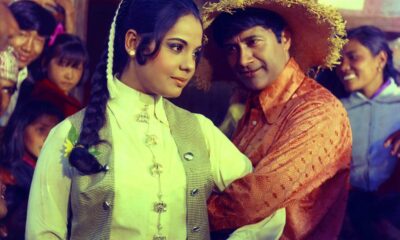
When Dev Anand sang Yeh dil na hota bechara qadam na hotey awara to khubsoorat koi apna humsafar hota, little did we know that there was a story behind this buoyant tune by Sachin Dev Burman.
Originally the tune was meant to be the title song in Guru Dutt’s Baharen Phir Bhi Ayengi. When for some reason Burman Dada couldn’t do the film he saved the tune for a later time. Who would have thought that the song with the vibrant visuals of Dev Anand with a fishing rod, stumbling in front of Tanuja and her friends’ car in Jewel thief would become a roaring hit?
Evergreen star, evergreen music. Dev Anand has always been synonymous with tunes that have withstood the test of time. His unerring ear for music has never let him down. From his first home production Afsar which launched Dev Anand’s Naveketan banner, to Censor, which concluded this long and breathtaking journey of a star, actor, filmmaker and musician named Dev Anand, songs and music were , and continue to be, an integral part of Dev Anand’s image as the jaunty boy nextdoor who was as urban as who was suave.
Among the trio of mega-stars who ruled the boxoffice in the 1950s Dev Anand was the consummate dandy. While a lot of folk music was associated with the screen images of his two super-contemporaries Dilip Kumar and Raj Kapoor, Dev Anand was seen as the urbanized suave and slick youth expressing a universal yearning to touch the sky on the wings of dynamism and exuberance.
The music in the films of Dev Anand was always young and animated. Even today when we hear Kishore Kumar doing Jeevan ke safar mein rahi milte hain bichad jaane ko, we are left with a feeling of being in the midst of a journey that has no beginning or end.
Dev Anand’s songs are often about the restlessness of young hearts. Whether it’s Yeh raat yeh chandni phir kahan sun ja dil ki dastaan in Jaal, Jayen to jayen kahan in Taxi Driver, Teri duniya mein jeene se to behtar hai ke mar jaayen in House No.44 , Hai apna dil to awaara in Solva Saal, Saathi na koi manzil in Bambai Ka Babu, , Main zindagi ka saath nibhata chala gaya in Hum dono , Rahi tha main awara in Sahib Bahadur , or Hum hain rahi pyar ke humse kuch na boliye in Nau Do Gyarah—these are ‘road songs’ long before this genre of popular music found currency in the American and European charts.
Dev Anand’s songs have influenced and impressed generations of stars who followed him. In Mahesh Bhatt’s Dil Hai Ki Manta Hai which was based on the same story as Nau Do Gyarah, Aamir Khan mimed the whole song Hum hain rahi pyar ke from the film Nau Do Gyarah. Later Aamir also starred in a film called Hum Hain Rahi Pyar Ke.
Look at today’s millennial heroes. Somewhere or the other, they all secrete a layer of Dev Anand’s personality. He was the MTV dude long before MTV was aired. The blithe spirit, the twinkle-eyed flirtatiousness and the never-say-die spirit were all contoured in his walk, talk and of course songs.
Born in Gurdaspur in Punjab, Dev Anand’s real name was Devdutt Pishorimal Anand. He came to Mumbai at the age of 20 to join his brother Chetan Anand in the cinema. Dev’s first film as an actor was Hum Ek Hain in 1946. It was the original Amar Akbar Anthony about three children who are brought up under differing religious beliefs. The film directed by Raj Kumar Santoshi’s father P. L. Santoshi had Husnlal-Bhagatram’s music and Guru Dutt’s choreography.
Even at the age of 20, the lad from Gurdaspur had a keen ear for music. Listen to Bahe na kabhi nain se in Vidya. This was Dev Anand’s first film with Suraiya and also the beginning of his long and extremely fruitful collaboration with composer Sachin Dev Burman. By the time Dev Anand produced Baazi in 1951, Burman Dada was as permament a fixture in the actor-filmmaker’s creative ambit as the enterprising spirit that took the Anand-Burman team through such melodic masterpieces as Sazaa(1951), Jaal(1952), Armaan(1953), Taxi Driver(1954), House No. 44 and Munimji(1955), Funtoosh(1956), Nau Do Gyarah, Paying Guest(1957), Kala Pani and Solva Saal(1958)…
By the time Dev Anand and Sachin Dev Burman arrived in the swinging 60s they were as inseparable as Kishore Kumar and Dev Anand. The songs that Burman Dada composed for Dev Anand to sing in Bambai Ka Babu, Ek Ke Baad Ek, Kala Bazar, Manzil, Baat Ek Raat Ki, Tere Ghar Ke Samne and Teen Deviyan in the first half of the 1960s ensured that Dev Anand’s superstardom was renewed in the decade when newer stars like Rajendra Kumar and Shammi Kapoor threatened the old order .
Instinctively Burman Dada understood how Dev Anand’s personality needed to be projected on screen. Just listen to Chupke se mile , Aye Kaash chalte, Khoya khoya chand, Abhi Na jao chodkar, Akela hoon mein and Dilka bhanwar kare pukar. These are the crème de la crème of Dev Anand’s celebrity status . No wonder when Sachin Dev Burman fell in ill 1964 and was replaced in plum assignments by other composers, Dev Anand decided to put his Guide on hold. “You take your time and get well. Guide won’t be made without your music,” Dev Anand had comforted the anxious and ill composer. Burman Dada lived up to the faith and trust that the producer-actor reposed in him. For Guide he came up with some of the best songs that have ever been lip-synced on screen by any matinee idol.
There’s a dash of existential philosophy in the songs, a touch of existential grandeur that every displaced youth of today in search of a resting place for his innermost impulses, would identify with. And giving an identity to these songs is the voice of Kishore Kumar. In the 50s and 60s when many sterling voices ruled playback singing Dev Anand still insisted on Kishore Kumar’s voice for a certain kind of song. Today as we listen to these immortal tracks we are filled with wonderment at the way the singer sings feelings and not just lyrics.
If the clothes make a man, then Kishore Kumar’s songs dressed up Dev Anand’s personality with magical finesse. We can’t imagine Dukhi man mere sun mera kehna or Jeevan ke safar mein rahi being sung for Dev Anand by any other singer but the inimitable Kishore. But a lot of the superstar’s songs were also sung by the other singing behemoths Mohd Rafi and Hemant Kumar. In the same year that Kishore Kumar sang those mouthwatering melodies in Munimji, Hemant Kumar did a double flip for Dev Saab in House No. 44.
But you really can’t separate the songs from the man. Whether it’s the quirky Aye meri topi from Funtoosh or the achy-breaky-heart-till-it-wounds Bharam teri wafaon ka from Armaan, every selection seems to have crossed boundaries of multiple choices before entering this anthology. There’s so much from Dev Anand’s films to choose from. If Kishore Kumar gave his best , Rafi Saab didn’t lag behind.
If the yodeller Kishoreda’s Mana janaab ne pukara nahin exudes an iressistible effervescence ,what do we say about Rafi Saab’s Hum bekhudi mein khud ko?
As Dev Anand once said, “An actor doesn’t have to be what he portrays on the screen. That’s the whole point of acting. You are constantly portraying persons who you are not in real life. I am quite a reserved person . I keep to myself and to my work. I don’t like going to parties and things like that.”
An introvert by nature Dev Anand opened up like the petals of a flower when he sang the songs of Kishore Kumar, Mohd Rafi and even Hemant Kumar. Songs were not just an extension of his personality. They were the liberating force which released the romantic within. But the romantic always remained a loner at heart. A majority of Dev Anand’s songs are about being alone in a crowd, about loving and yet remaining privately marooned in love which somewhere and somehow, even excluded the person whom the singer expressed love to.
The feelings were always a distant dream. But the voices kept changing sometimes within the same score. How do we decide who gave more to the lyrics Aise to na dekho ke humse khataa ho jaye and Khwab ho tum ya koi haqeeqat in Teen Deviyan, Mohd Rafi or Kishore Kumar? By the time Dev Anand entered the 1970s it was more or less decided that Kishore Kumar would now become Dev Anand’s permament ghost voice. When he turned director in 1970 with Prem Pujari it was good old Sachin Dev Burman doing the music score.Neeraj’s nifty words in Phoolon ke rang se dil ki qalam se tujhko likhi roz paati are as transparent and lucid as a stream flowing into a river of life. A poetic and profound song like
Phoolon ke rang se reminds us how far Dev Anand’s screen persona was extended by the songs he sang on screen.
For his second directorial venture Hare Rama Hare Krishna Dev Anand wanted to return to his favourite music composer . But Sachinda gave Dev Anand good advice. “This seems to be a film about today’s youth. And I think my son Rahul would be far better equipped to score music for this film.”
That’s how a new youthful phase in the 48-year Dev Anand’s life and career began, a phase when he graduated from the mock-melancholy of S.D. Burman’s Yeh dil na hota bechara to the bona fide social concern of son R.D. Burman’s Dekho oh diwanon tum yeh kaam na karo Ram ka naam badnaam na karo.
The son never set on Dev Anand’s musical empire. It never can. His songs mean many different things to different people. The heightened romance of Ishq ishq ishq and the parodic lightness of Dheere se jaana khatiyan mein(in which Sachin Dev Burman parodied his own 40’s song Dheere se jana bagiyan mein) there’s life beyond the immediate song in this collection. And that life comes from underneath rather than the surface of each number.
Dev Anand once said, “Everyone wants to be the best and everyone works for it too. They guard their positions zealously…I wouldn’t let anyone else take the limelight. That’s my ego as an actor.”
Just as no one can replace Dev Anand as a star-actor, no one can snatch away the songs that define and underline his career. No matter how he see it, there’s something very special about the music in Dev Anand’s cinema. Something special and irreplaceable. Something fragile and yet strong and invincible.
Once Dev Anand had said, “My work keeps me going. That’s the way I am and that’s why I don’t like looking back.” But when one looks back at such a vast and powerful storehouse of melodic moments and memories one cannot but salute the strong sonorous side of Dev Anand. His indefatigable energy ,his sense of discipline have stood by him for more than five decades.
“I can pinpoint and motivate myself towards a set goal. I don’t let any moment slip out of my fingers,” Dev Saab once confessed.
Isn’t that the philosophy of life that’s reflected in his songs? Dev Anand Zindagi ka saath nibhate chale ja rahen hain. He feels, “With the years you become wiser. Mentally and physically, your faculties are at their peak. I’ll continue working till it becomes physically impossible.” And the songs of Dev Anand shall continue to enchant us for as long as there ‘s sound and melody on this earth.
What sets the songs of Dev Anand apart from others? That’s easy to answer. In one word, it’s their timelessness. 64 years ago Dev Anand sang Main zindagi ka saath nibhata chala gaya har fiqr ko dhuen mein udata chala gaya. Today the song remains as richly relevant as a signature tune for the young and on-the-go Indian as it was back then.