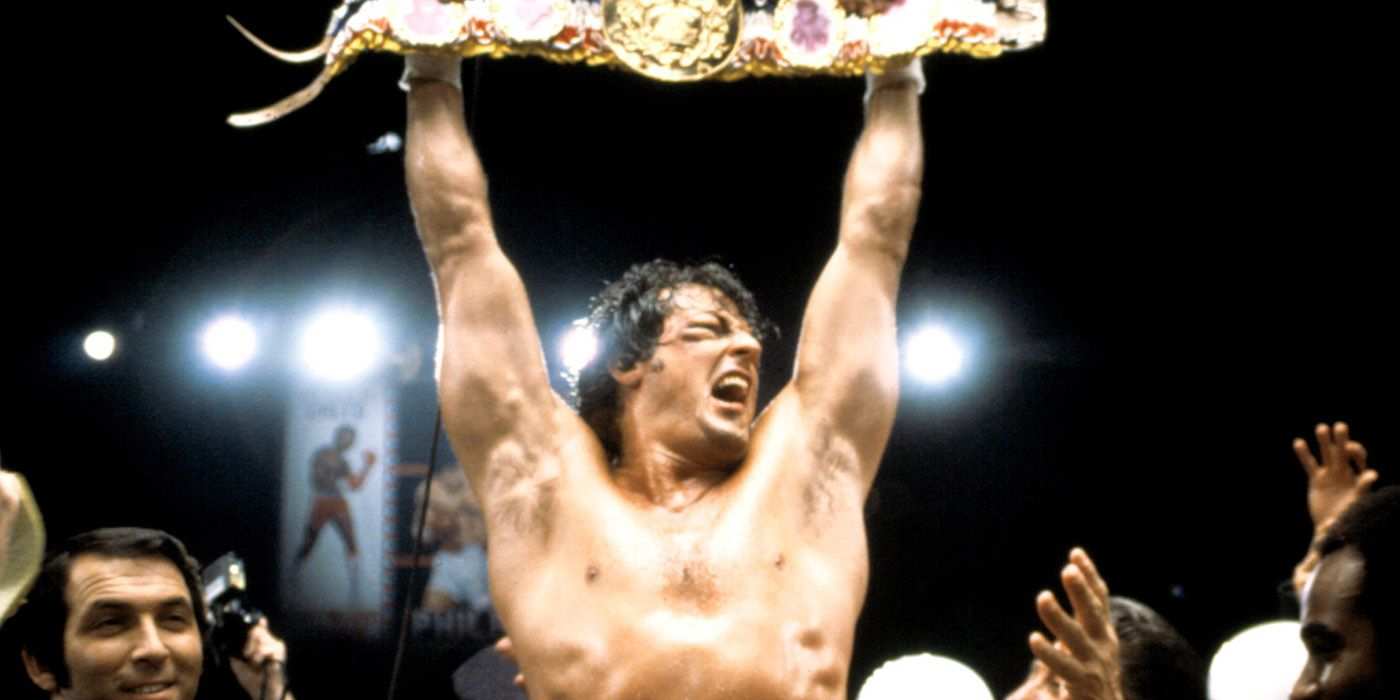
If 1976’s Rocky was about a boxing underdog going the distance, Rocky II was about proving that courage is more than achieving fifteen minutes of fame. Sylvester Stallone’s breakout character had evolved from a centerpiece of the New Hollywood era of cinema to a blockbuster franchise with its 1979 sequel. In turn, a studio producing the follow-up to the Academy Award-winning drama played a major role in getting the next great boxing-themed classic to the screen: Raging Bull.
While the success of the original Rocky with its surprise box office success and Oscar achievement for “Best Picture” signaled an opening for boxing-themed movies, that did not necessarily mean major Hollywood studios would greenlight just any story involving the squared circle. Such was the case with Martin Scorsese’s 1980 masterpiece starring Robert De Niro as Jake LaMotta. Earning worldwide acclaim upon release, holding a certified fresh 92% Rotten Tomatoes score, Raging Bull is considered by professional critics as not only one of Scorsese’s best but also one of the greatest movies of all time. However, the controversial life of LaMotta, being far from the redemption fairy tale of Stallone’s Rocky Balboa, nearly scared off studio United Artists from making Raging Bull a reality.
Martin Scorsese Was Near Death When Robert De Niro Got Him to Direct ‘Raging Bull’
As discussed in Scorsese’s recent Apple TV docuseries, Mr. Scorsese, the legendary filmmaker behind Mean Streets and Taxi Driver, was in the early days of his initial Hollywood success when he had a terrible addiction to cocaine. The years of substance abuse, as well as the stress of filmmaking with intense work and fights with the studios, resulted in a near-fatal drug overdose at age 35. While hospitalized, Scorsese was visited by De Niro, who tried to convince his close friend that he should take on Raging Bull as his next picture. The actor was often seen reading LaMotta’s 1970 memoir, Raging Bull: My Story, during production of Taxi Driver and believed Scorsese had the skill to bring LaMotta’s story to the screen.
Up to this point in his career, Scorsese was primarily known for gritty urban dramas while showing his versatility, taking on projects outside his wheelhouse, including the romantic drama Alice Doesn’t Live Here Anymore and the musical New York, New York. Sports, however, was not a topic that Scorsese had an interest in. But De Niro did not relent in his pleas to a bedridden Scorsese as the Oscar-winning actor stated in the docuseries, “What the hell do you want to do? Do you want to die like this?” before the filmmaker finally agreed.
Working with screenwriters Mardik Martin and Paul Schrader, Scorsese put Raging Bull into development with Rocky producers Irwin Winkler and Robert Chartoff. Yet, upon the script’s completion, Winkler recalls a meeting with himself, De Niro, and the UA executives who questioned the star, asking, “Why would you want to play this cockroach?” De Niro responded otherwise to the executives. However, it raised a point in the studio’s reluctance to greenlight a biopic about LaMotta. The middleweight fighter dubbed “The Bronx Bull” may have had legendary bouts with Sugar Ray Robinson. However, Lamotta was notorious for his explosive behavior outside the ring, violence towards women, and engaging with organized crime by taking dives for fights later in his career. The controversial fighter’s life was lacking sympathy, making it a difficult subject for any film studio to market to mainstream audiences. A trade-off was needed to get Raging Bull made, and Winkler had an ace up his sleeve: A new Rocky movie.
‘Raging Bull’ Would Not Exist Without ‘Rocky II’
Since the release of Rocky, the character had caught on with a renewed American spirit following the turbulent years of the Nixon Administration and the Vietnam War. Audiences flocked to theaters to see the overlooked Philadelphia club fighter find love while earning a once-in-a-lifetime shot against the champion of the world. Though Stallone’s underdog hero fell short of winning the match against Apollo Creed (Carl Weathers), the prospect of big money for a cinematic rematch was real.
As Winkler discussed in Mr. Scorsese, UA executives saw more commercial potential in Rocky II than in the dark rise-and-fall tale of Raging Bull. Determined to see Scorsese’s boxing drama get made, Winkler told the executives that the Stallone-led sequel can only happen if they agree to greenlight Raging Bull as well. Ultimately, the deal paid off, with Rocky II becoming another box office smash and Raging Bull going on to win two Oscars for “Best Actor” and “Best Picture”.
Though Rocky II was another crowd-pleaser that ensured more stories to come for the Italian Stallion with four additional installments and the successful Creed franchise, Raging Bull was simply a one-of-a-kind boxing movie. It was less to do with LaMotta as a fighter and more of Socrsese’s portrait of a man literally stripping every ounce of humanity until there’s nothing else left to connect with. The fighter’s inner torment that drove his repulsive behavior was exactly what Scorsese identified with during this turbulent period of his own life, believing that LaMotta was not “a cockroach” but a victim of misfortune.
It remains an ironic moment in cinema history that an instant classic like Raging Bull nearly went unproduced because of its subject matter. Winkler told NPR in 2007, “The sad thing is that Raging Bull might have never been made and probably wouldn’t have been made unless we took that position on Rocky.”
Raging Bull is available to stream on Prime Video in the U.S.

- Release Date
-
December 19, 1980
- Runtime
-
129 minutes
- Writers
-
Mardik Martin, Paul Schrader